
Printable PDF Edition
Prefer a copy you can hold, reflect on, or share?
This article is available as a complimentary printable PDF for personal reflection, leadership conversations, team discussions, faith and community settings, or simply for reading away from the screen.
Read it. Print it. Reflect on it. Share the conversation. No email required.
Holiday Eating Without Guilt: A Root-Cause Approach to Food, Stress, and Energy
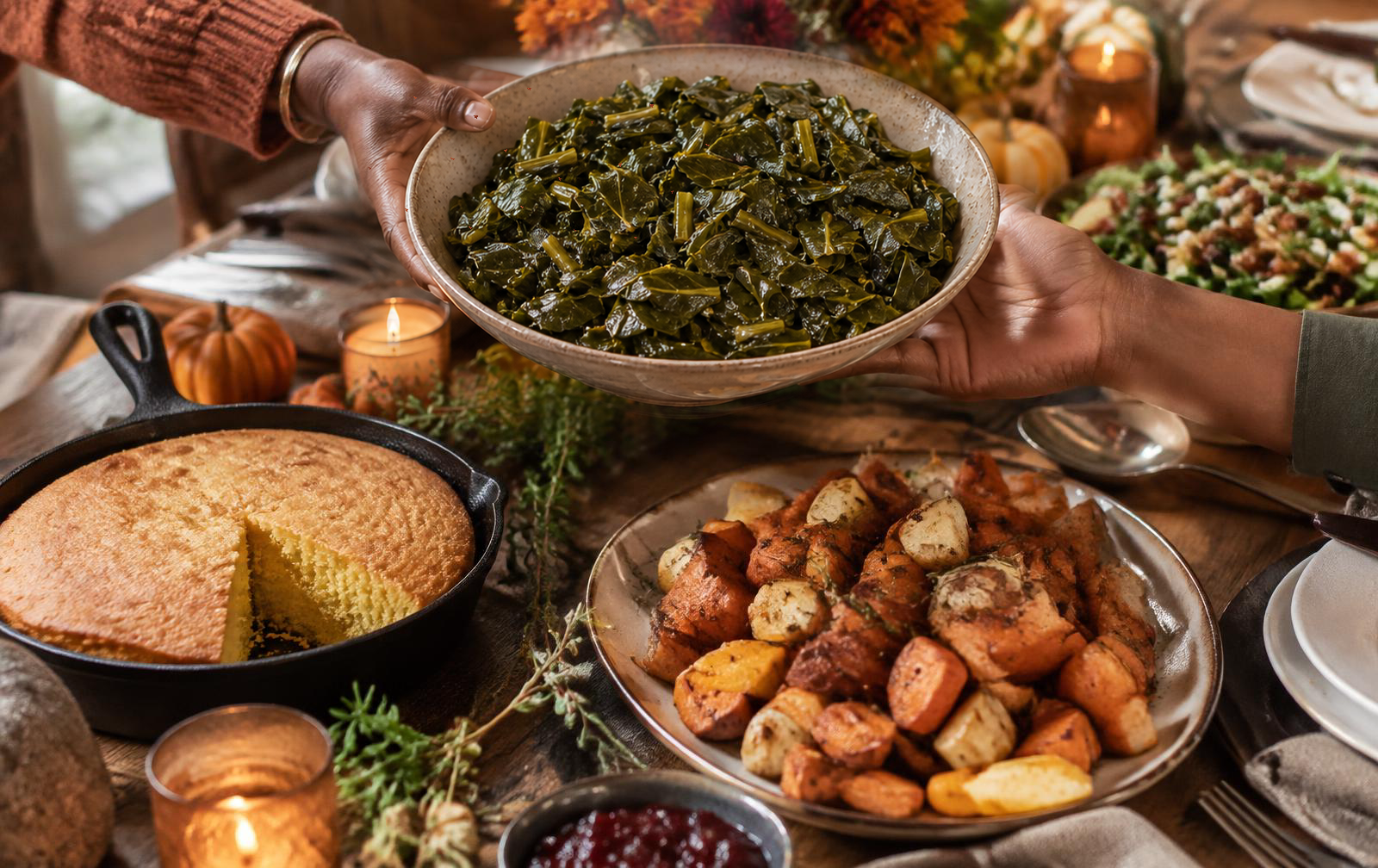
One of the earliest places I learned about nourishment was in the garden with my grandfather, Charlie Kee.
He taught me how to sow, fertilize, harvest, clean, and cook collard greens. But the garden taught me something beyond growing food: every season requires discernment.
As fall arrives, a gardener considers:
- What should be kept?
- What needs to be changed or pruned?
- What could be planted or created for the next season?
- What has completed its purpose and can be released?
I believe the same questions can help us approach the holiday table with greater awareness, compassion, and intention.
Sometimes Food Gets Blamed for What Capacity Has Been Carrying
Holiday food often receives the blame for discomfort, fatigue, weight concerns, or feeling “out of control.”
But the holiday table is rarely only about food.
It may also carry:
- Travel and disrupted routines
- Inadequate sleep
- Financial pressure
- Grief and missing loved ones
- Family expectations or conflict
- Hosting and caregiving responsibilities
- Packed schedules
- Emotional labor
- The pressure to make everything meaningful for everyone else
Food also carries memory, culture, family, faith, comfort, celebration, tradition, belonging, and connection.
Before blaming the plate, it may be helpful to consider what your body, mind, heart, environment, and spirit have been carrying into the room.
What Does the Research Tell Us?
Holiday weight gain is often discussed as though several pounds are inevitable.
However, a prospective study of 195 adults found an average holiday-period gain of approximately 0.37 kilograms—or about 0.8 pounds. That was considerably less than the five-pound gain people commonly expected.
The same study found that, on average, the modest increase was not reversed during the following spring and summer. That is a reason for awareness—not fear, shame, or extreme restriction.
Food is only one part of the seasonal picture.
In a 2023 American Psychological Association survey, 89% of adults reported that concerns such as finances, missing loved ones, and anticipated family conflict contributed to holiday stress.
The American Psychiatric Association’s 2025 Healthy Minds Poll found that:
- 48% worried about missing someone or experiencing grief.
- 46% worried about affording or finding gifts.
- 32% worried about difficult family dynamics.
- 53% looked forward to enjoying good food.
The holidays can hold joy and strain at the same time.
That is why a sustainable approach cannot focus only on controlling food. It must also recognize the conditions surrounding our choices.
Support, Not Restriction™
Instead of asking:
“How do I control myself so I do not overeat, gain weight, or regret what I eat?”
Consider asking:
“How can I nourish and steward myself with compassion and love?”
That shift may include several forms of support.
Nourishment
Arriving at a gathering extremely hungry may make it more difficult to notice hunger, satisfaction, and personal preferences.
Consistent nourishment earlier in the day can help you approach the table with greater awareness instead of urgency.
Hydration
Busy schedules, travel, heating systems, celebrations, and changes in routine can interrupt normal hydration patterns.
Hydration does not need to become another rule. It can simply remain part of how you support yourself throughout the day.
Rest
Fatigue can influence attention, decision-making, and appetite.
A 2017 meta-analysis of controlled intervention studies found that partial sleep deprivation was associated with an average increase of approximately 385 calories in next-day energy intake. That does not predict any one person’s response, but it reinforces that sleep and appetite regulation are connected.
Sometimes what feels like a lack of discipline may also involve an under-rested body seeking energy.
Movement
Movement does not have to be used to earn food or compensate for eating.
A walk, stretch, dance, or few minutes outside can support circulation, digestion, emotional regulation, and connection.
Connection
For many people, the most meaningful nourishment at the holiday table is not found on the plate.
It may come through laughter, prayer, remembrance, storytelling, conversation, or simply being present with people who matter.
Enjoyment
Pleasure is not the enemy of wellness.
Enjoying meaningful foods slowly and intentionally may help you remain connected to both the experience and your body.
Keep · Change · Create · Release™
The fall garden offers a simple framework for approaching the season.
KEEP
What traditions, foods, relationships, and practices genuinely nourish you?
CHANGE
What could be adjusted to provide more support?
Perhaps the recipe remains soulful while one ingredient changes. Perhaps the gathering remains meaningful while your role becomes more sustainable.
CREATE
What new rhythm, boundary, tradition, or form of support would help you remain connected to yourself?
RELEASE
What guilt, perfectionism, pressure, or inherited expectation no longer needs to accompany you into this season?
Releasing does not mean rejecting your family, faith, culture, or traditions.
Sometimes it means making room to experience them more fully.
Prepare · Prioritize · Prosper
Research on implementation intentions suggests that connecting a specific situation with a planned response—an “if-then” plan—can improve follow-through.
For example:
- If travel delays the meal, then I will use nourishment I packed.
- If I begin feeling overwhelmed, then I will step outside for five minutes.
- If someone pressures me about food, then I will use the boundary statement I prepared.
This is part of the P3 for Success™ approach:
Prepare: Anticipate what may affect your capacity.
Prioritize: Decide what matters most in this season.
Prosper: Move through the experience without abandoning yourself.
Food Literacy Without Food Fear
Food literacy does not require labeling every food as good or bad.
It invites thoughtful questions:
- What am I eating?
- How was it prepared?
- How does it make me feel?
- What meaning does it carry?
- What does my body need alongside it?
- What choice aligns with how I want to nourish and steward myself?
The goal is not to get through the holidays perfectly.
The invitation is to move through them without leaving yourself behind.
Looking for Personalized Support?
If you are ready to explore the patterns influencing your energy, resilience, and well-being more personally, you are invited to begin with a Root Cause Discovery Session™.
Explore the Root Cause Discovery Session™
This article is provided for educational and coaching purposes and does not diagnose, treat, or replace medical or mental-health care. Consult an appropriately licensed healthcare professional regarding individual symptoms, conditions, or treatment decisions.
References
- Yanovski, J. A., et al. (2000). A prospective study of holiday weight gain. The New England Journal of Medicine, 342(12), 861–867.
- American Psychological Association. (2023). Even a joyous holiday season can cause stress for most Americans.
- American Psychiatric Association. (2025). Americans are more anxious about the upcoming holidays.
- Al Khatib, H. K., et al. (2017). The effects of partial sleep deprivation on energy balance. European Journal of Clinical Nutrition, 71(5), 614–624.
- Gollwitzer, P. M., & Sheeran, P. (2006). Implementation intentions and goal achievement. Advances in Experimental Social Psychology, 38, 69–119.